Holy Trinity Sunday
Genesis 1:1-2, 4a; 2 Corinthians 13:11-13; Matthew 28:16-20
I have a couple of
riddles for you:
What did the rug say to the floor? “I’ve got
you covered!”
What did George say to his friend Joe when
the check for their meal arrived and Joe realized he didn’t have his wallet?
“Don’t worry. I’ve got you covered!”
What did the police detective say to her
partner before she advanced toward the suspect’s door? “I’ve got you covered.”
 God’s message to us this day and always is, I’ve got you covered. And on Trinity Sunday, we marvel in all the
ways that our creating, redeeming, sanctifying God says to us, I’ve got you covered.
God’s message to us this day and always is, I’ve got you covered. And on Trinity Sunday, we marvel in all the
ways that our creating, redeeming, sanctifying God says to us, I’ve got you covered.
God has us covered through God’s creative activity
where God creates the world around us in an ongoing dynamic and dramatic creation
story. God’s creation includes every bird, bee, cloud, person, drop of water,
mountain, sea, and so on.
God has us covered through the grace we
receive, a free gift through the redeeming work of Jesus, our Lord and savior who
continues to teach us through God’s Word, strengthen us through his body and
blood as he comes to us in Holy Communion, and forgives our sins daily through
the ongoing work of the cross.
And God has us covered through the Holy
Spirit, the one who gathers us here together, who grants us faith and vision,
and inspires and enlightens our path.
The concept of one God in three persons is a
stumbling block for some, and a mystery for us all. We are human. We are finite
beings, with limited understanding and imagination. Through all our coming and
going, through all our activity, through our joy and our sorrow, God promises
never to leave us alone. Instead, God’s loving refrain to us is, was, and
always will be, “I’ve got you covered.”
 Of course, as human beings, we struggle to
understand or articulate who God is
or how God functions. So, very early
in the life of the church, our forefathers struggled to develop a common
expression of what, based on the Scriptures and our own experience, we believe
about the nature and function of God. The result of this work? Creeds that are
still in use today. Through the creeds, these statements of faith, we confess
what it is that we believe about the nature of God.
Of course, as human beings, we struggle to
understand or articulate who God is
or how God functions. So, very early
in the life of the church, our forefathers struggled to develop a common
expression of what, based on the Scriptures and our own experience, we believe
about the nature and function of God. The result of this work? Creeds that are
still in use today. Through the creeds, these statements of faith, we confess
what it is that we believe about the nature of God.
One of those is the Athanasian Creed, which
some of you may remember. It was printed in our previous hymnal, the green one;
it took up an entire page and a half. You won’t find it in the hymnal we
currently use, since the Athanasian Creed has gone largely out of use in our
churches. However, in some congregations it is still pulled out once every year
- on this particular Sunday - and
recited by the entire congregation, as an articulation of trinitarian belief.
Because I love you and see no need to punish you
in that way, we’ll skip the Athanasian Creed today, except for this which comes
directly from it: “Now this is the
catholic faith: We worship one God in trinity and the Trinity in unity, neither
confusing the persons nor dividing the divine being.”
God in trinity…..Trinity in unity. As
confusing as it is, those simple phrases contain the core of our faith – that
our God comes to us as the glorious, mysterious three-in-one, and that through
the Trinity, God says to us, “I’ve got you covered.”
So what
is it that we believe about the three persons of the godhead? Each week
when we come together we state our belief. On festival Sundays we use the more
formal language and form of the Nicene Creed. But the more commonly known and
recited Apostles’ creed is the one that we, together with Christians around the
world, pray together week after week.
As the most common expression of faith,
Martin Luther broke down the Apostles’ Creed for us in the Small Catechism, as
a way to help families teach and learn what it is that we believe about God.
Recently, each family received a pocket-sized
copy of Luther’s Small Catechism, which I’m sure you have with you, since you
faithfully study it at every opportunity, right? Would please pull it out now,
and we’ll take a look at the Apostle’s Creed together. What? You don’t have it?
Ah!
Well, I’ve got you covered! In the back of
each hymnal you will find the Small Catechism. If you’ll take out your hymnal
and turn to page 1162 you will find the Apostles’ Creed.
Luther breaks the creed down into three
manageable articles, one devoted to each person of the Trinity. The first
article is, “I believe in God, the Father almighty, creator of heaven and
earth.”
Seems simple enough. Together, let’s read
what Luther has to say about what that means:
I
believe that God created me with all that exists. God has given me and still
preserves my body and soul: eyes, ears, and all limbs and senses; reason and
all mental faculties.
In
addition, God daily and abundantly provides shoes and clothing, food and drink,
house and farm, spouse and children, fields, livestock, and all property –
along with all the necessities and nourishment for this body and life. God
protects me against all danger and shields and preserves me from all evil. And all
this is done out of pure, fatherly, and divine goodness and mercy, without any
merit or worthiness of mine at all! For all of this I owe it to God to thank
and praise, serve and obey him. This is most certainly true.
Wow – one simple sentence, but what it says
about God is both more broad and complex than we might suspect at first.
 The second article of the Apostles’ Creed
reads: “I believe in Jesus Christ, God’s only Son, our Lord, who was conceived
by the Holy Spirit, born of the virgin Mary, suffered under Pontius Pilate, was
crucified, died, and was buried; he descended to the dead. On the third day he
rose again; he ascended into heaven, he is seated at the right hand of the
Father, and he will come to judge the living and the dead.”
The second article of the Apostles’ Creed
reads: “I believe in Jesus Christ, God’s only Son, our Lord, who was conceived
by the Holy Spirit, born of the virgin Mary, suffered under Pontius Pilate, was
crucified, died, and was buried; he descended to the dead. On the third day he
rose again; he ascended into heaven, he is seated at the right hand of the
Father, and he will come to judge the living and the dead.”
Again, let’s read together how Martin Luther
unpacked this statement: I believe that
Jesus Christ, true God, begotten of the Father in eternity, and also a true
human being, born of the virgin Mary, is my Lord. He has redeemed me, a lost
and condemned human being. He has purchased and freed me from all sins, from
death, and from the power of the devil, not with gold or silver but with his
holy, precious blood and with his innocent suffering and death. He has done all
this in order that I may belong to him, live under him n his kingdom, and serve
him in eternal righteousness, innocence, and blessedness, just as he is risen
from the dead and lives and rules eternally. This is most certainly true.
And finally, we have the third article, which
describes the work of the Holy Spirit who, among other things, makes us holy:
“I believe in the Holy Spirit, the holy catholic church, the communion of
saints, the forgiveness of sins, the resurrection of the body, and the life
everlasting.”
My friends, in the words of Martin Luther,
“What does this mean?”
I
believe that by my own understanding or strength I cannot believe in Jesus
Christ my Lord or come to him, but instead the Holy Spirit has called me
through the gospel, enlightened me with his gifts, made me holy and kept me in
the true faith, just as he calls, gathers, enlightens, and makes holy the whole
Christian church on earth and keeps it with Jesus Christ in the one common,
true faith. Daily in this Christian church the Holy Spirit abundantly forgives
all sins—mine and those of all believers. On the last day, the Holy Spirit will
raise me and all the dead and will give to me and all believers in Christ
eternal life. This is most certainly true.
These are the things we believe about who God
is and how God works. Yet it is not even our belief here that matters, or the
words we put together, but what God is doing that creates meaning and
difference. All evidence points to the truth and makes it clear that through
divine activity and care, God has us covered.
From the beginning of creation, through the
exodus and the wilderness years, all through the history of our salvation to
the sending of God’s own Son, Jesus, God has had us covered. As Jesus was preparing
his disciples for life, mission and ministry following his resurrection, Jesus
sends his disciples out, giving them authority to speak and work in his name,
knowing that no matter what might befall them, “I’ve got you covered – always –
to the end of the age.” And finally, through the Holy Spirit’s power and
presence, God has us covered.
In our gospel text, Jesus gathers the
disciples together and sends them out, blessing them and commanding that they
bless and baptize others in the name of God – Father, Son and Holy Spirit.
In our Epistle reading, Paul aims to bring
the Corinthians, those disagreeing, bickering, recalcitrant brothers and
sisters of the early church into order, agreement, and peace – and invites them
into knowing peace and unity by the sharing of a holy kiss. He reminds them
that they, too, are church whose purpose it is to go out, in the name of Christ
and with the blessing of Father, Son, and Holy Spirit – God’s own “I’ve got you
covered.”
Our texts today emphasize how, from the
beginning of our existence and beyond, God has had it all covered, creating in
great detail all that would be needed to sustain life and make it beautiful. Redeeming
it through the love of Christ, who passes on the mission to share and spread
the word of God’s glory, majesty and care – God’s own “I’ve got you covered.”
As we read these texts all together on this
Trinity Sunday, we are reminded that God’s love is evident in all the comings
and goings of our lives, and that the blessing within each of these texts is
ours.
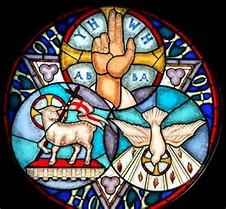 In love, God has provided for our every need
through the creation of the world, the salvation of our sins, and God’s ongoing
presence in our lives through the abiding presence and work of the Holy Spirit.
In love, God has provided for our every need
through the creation of the world, the salvation of our sins, and God’s ongoing
presence in our lives through the abiding presence and work of the Holy Spirit.
It
is hard as human beings to
fully grasp the concept of Trinity – one God, three persons, equal in majesty,
co-equal in eternity – as the Athanasian Creed would remind us. The important
thing to remember is that despite our struggles to believe, to understand or
even, sometimes to confess, through the means of grace, God truly does have us
covered, empowers us to gather and then to go, never alone, to share God’s story
of love with those we encounter. Thanks be to God!
Amen.


