Search This Blog

Showing posts with label Grace. Show all posts

Monday, April 1, 2019

Many Stories, One Voice


Luke 15:1-3, 11b-32
            As we read the gospel this morning, you voiced the parts of the two brothers – the younger son, who went away for a time and then returned to the homestead, perhaps only seeking survival, but receiving grace far beyond his imagining;  and the elder son had stuck around and unfailingly persisted in trying to do the right thing, consistently receiving all that he needed all along, but never really appreciating that fact.
I wonder how reading both parts felt to you? Which voice felt most authentic to you – most like your own experience, most like the character you can relate to?
Most of us have probably heard this parable many times. Therefore, the word, “prodigal,” has become part of our lexicon, and it has come to mean something rather specific to us. So, when we hear someone referred to as a prodigal, or even refer to themselves as such, what do we think of? What assumptions do we make about a person who is a “prodigal”?
Very often, the prodigal is one who has turned away from and rejected familial relationships. The prodigal is one who seems to have moved the family system to a place of irrevocable brokenness. (You know the saying, “A mother is only as happy as her least happy child? It goes for the entire system.) We’ve each probably known someone like that at some time in our lives. Perhaps we’ve been that person.
The story of the Prodigal Son may strike some of us uncomfortably close to home, because there is some aspect of the story that we are living out today.  Someone is lost; someone is missing; someone, while still living, is as good as dead.
Sadly, for some who are locked into situations like this, hurts suffered have never healed and now feel beyond healing – a life has ended, and with it opportunity for reconciliation may be passed. Instead, a scar resides deep within.
Prodigals are created  when someone has “fallen from grace” through decisions made, alternative alliances forged, (like falling in with the wrong people), suffering failures of our own making, or abandoning the relationships and norms that surround them.
If you have ever been a part of a prodigal story, regardless of which character you have been, know that it is with sincere empathy for each of the characters here, that we approach this story today.
While it may be easy to place ourselves somewhere in the story, this parable does not stand alone, but is part of a larger narrative in which Jesus responds to those challenging him by telling three stories that center on the experiences of loss and grace.
The situation is this: the Pharisees and scribes were Kvetching about the social activities of Jesus. He has been spending time with, and even eating with tax collectors and sinners. (Imagine that!) He has been hanging out with outcasts and undesirables. (Oh, my!)
It might be really satisfying for us right now if Jesus just set the record straight and put them in their places.
Instead, (this being Jesus) he tells these three parables – stories in which it is unquestionably clear that God loves and behaves differently than we do, and that God values sinners more than we could ever imagine, (which is good news for all of us!).
As Jesus moves from parable to parable, story to story, he barely takes a breath. He begins with a woman who finds a lost coin – just one coin among many she may own – because of its importance to her, and when she finds it celebrates with great joy and wild abandon.
Then he tells about a celebration that goes on when one measly sheep out of an entire flock is found after wandering away and becoming lost.
And finally, he tells about this huge bash given in honor of the most unlikely of recipients: a kid that was not simply lost, hadn’t just wandered away, but has behaved in the most egregious and outrageous manner, demanding an early pay-out on his inheritance, and then abandoning his father and all that connects him to this place.
What makes this story so interesting and how over-the-top all of the characters behave.

  • The father, rather than setting his son straight to begin with, gives in to his demands, and hands over the goods.
  • The son then squanders everything and finds himself not just in a bad situation, but destitute – literally in a life-threatening condition.
  • The place where he now resides goes through a famine and not one person will offer him assistance.
  • He finally takes a thoroughly demeaning job but even then isn’t even given so much as the carob pods which he has to feed to the pigs to eat himself. No one there cares anything about him or his welfare.
  • Finally he decides to return to his father and appeal to his compassion and hope for at least the same as the very least of his father’s hired hands would receive, which is more than he has now.
  • Then, the most ridiculous thing of all happens: before he can even say a word, while he still just a speck on the horizon, his father runs to him, overjoyed, with arms outstretched.

It’s all quite scandalous, really, but only the elder son in the story seems to know that. Of course, he has his own gripe, because not only has the father behaved shamefully weak and gullible, in his overzealous rush to welcome home his boy, the elder son has felt totally disrespected.
Here this brother of his so cruelly and uncaringly cut himself out of the family, yet is given the hero’s welcome, while here he stands, the polar opposite – faithful, dutiful, hard-working, loyal son – the son who has slaved and tried so hard to always do the right thing. He is flabbergasted to see his brother receive what it is he himself has always wanted – recognition, favor, the party!
This, my friends, is a story of extremes. The father’s over-the-top forgiveness and love for his sons is book-ended by their outrageous behavior.
The thing is, in our reading of this story, while the words and actions of one son may have resonated more than the words and actions of the other son today, many of us may have found ourselves in the shoes of both sons at one time or another in our lives.
The point that this parable makes is poignant for whatever your story might be. There is genius in that, because the truth is that God’s grace is every bit as scandalous and ridiculous as the picture we get of the father in our story. And it doesn’t matter which brother’s actions reflect our own, God’s love is big enough and God’s grace sufficient enough for us all.
The story speaks as much to our lives as it did to the lives of both Gentile and Jew, Pharisee and outcast, sinner and rule-follower, prodigal and elder-brother of Jesus’ day. And the point Jesus makes is just as timely for us today as it was for those for whom these stories were originally written.

It boils down to this: in God’s economy, there is plenty of grace to go around, and God spreads it over each of us as we have need. It is God’s desire that none of the sheep who go astray be lost forever; that the coin that found its way into a corner somewhere is just as precious and necessary to God’s kingdom as any other coin in the purse; and that the gospel is for everybody – rule follower and prodigal alike.
That is indeed good news for all of us. For those of us who seemingly hit rock bottom before we realized that we were invited to the great feast, and sometimes still feel like we’re dangerously close to the bottom of the pit, God especially reaches out to you in love and forgiveness. God wants you to know that you are welcome and cherished, and you are, through the mercy of Jesus Christ, forgiven.
For those of us who have been around here for years, and for those who just started attending church or coming to the table yesterday, God’s grace embraces you equally; you belong here and are equally members of the Body of Christ. For those of us who struggle to get through each day and for those who really have ourselves all pulled together, God love and grace are poured out on you in sufficient quantities to for exactly the need you have. For those who can quote scripture chapter and verse and those who have difficulty distinguishing the Old Testament from the New, God knows your hearts in equal measure and has already surrounded you with God’s compassionate love. You belong to him.  
The good news of the Gospel of Jesus Christ is that it is for everyone. All are invited to the table and in God’s perfect grace it is large enough for us all.
God’s love does not discriminate, it transforms. It doesn’t matter where you have come from or where you are today – in Jesus Christ, God’s grace covers you. The good news of God’s scandalous, ridiculous grace is for those who have always been the straight arrows and for those who have followed the crooked path. And since God’s love enfolds every cherished person, how can our welcome do any less?
God rejoices in the person God has created you to be. It doesn’t matter the color of your skin, the language you speak, or the country from which you or your ancestors derived, your gender, your age, or your sexuality. God’s love enfolds you.
As we read this parable, we acknowledge that we need to die daily to sin and rise to new life in Christ, which is the gift of our baptism. But, only when we are able to let go of our resentment, judgment of the other, bitterness and hatred may we learn what new life and new creation truly mean; it is the radical, scandalous, and ridiculous love of God and God’s eternal and unending grace that we receive through Jesus that will finally, when all is said and done, free us from our own lost paths and need for justification.  
My brothers and sisters in Christ, prodigals all are we. May we live in gratitude that even in his final act from the cross, when he forgave another prodigal, the criminal beside him, Jesus showed us how unfathomably scandalous and huge is the grace of God. Praise be to God! Amen.


Sunday, October 28, 2018

Freedom, Truth, and Luther


 Jeremiah 31:31-34; Romans 3:19-28; John 8:31-36

There is a television program called “This is Us” which has become quite popular in the past couple of years, but until recently I had never watched any of its episodes. Lately, however, curiosity has had me watching the first couple of seasons through a streaming app. This week I watched an episode in which one of the characters talks about the first time he got glasses with corrective lenses in them.
Before he could get the glasses of course, came the exam with what he calls the “Better Machine.”
Anyone who has had optical refraction is familiar with that machine. (Refraction is what they call it when they check to see how much – or how little correction your eyes might need to attain your best possible vision).
So, the “best machine” is the one where the doctor or optical technician flicks through combinations of varying strengths of lenses on a machine that you look through to read the chart on the wall. As lenses are changed, the patient is asked over and over, “Which is better, one or two?” click, click, “now which is better – one or two?” click, click, “two or one?”
The patient goes through a series of trial lenses in this way, while the world goes from blurry to clear and back to blurry again, until you finally arrive at the combination that provides the best correction you can attain to see the world.
I remember walking out of the optician’s office with my first pair of glasses when I was in fourth or fifth grade. I was amazed that the grassy lawn contained millions of individual blades of grass – and was not just the sea of green I had become accustomed to seeing. That’s what I remember most of that first step out into a vision-corrected world – individual blades of grass.
Today we commemorate Reformation Sunday, when we remember with gratitude the work of Martin Luther and the rest of the reformers, who gave us a clearer vision of God’s grace through their work with the Scriptures. We celebrate how, through the Reformation, our faith came to contain millions of beautiful blades of grass as we see God’s presence throughout our world, no longer a simple one-or-two-dimensional sea of green.
Luther and his friends never intended to split the church, or to create a new denomination in the Christian faith. They simply wished to share with the masses what they, through the power of the Holy Spirit, had come to understand more clearly; that what God has done in Jesus Christ, on the cross, is to pour our grace sufficient for new life for us all.
They wanted to devise better ways to teach the faithful that God’s unmerited, perfect grace is already accomplished for us all. They were, in a lot of ways, like the “better machine.”
They kept writing, studying, arguing and debating with each so that they could best understand and then convey the truth of Christ’s Word that is life-giving and not oppressive, as Jesus himself is life-giving and liberating.
In so doing, they looked through a variety of lenses and asked the question over and over, “which is clearer, one or two? two or one”? As they worked, their vision went from blurry to clear, back to blurry again, and then clearer than ever before, through reading Scriptures like those ones we just read.
Jesus said to the Jews who had believed in him, “If you keep on living in my truth, you are really, truly my disciples; and you will know the Truth, and the Truth will make you free.”
The disciples answered him, “We are descendants of Abraham and have never been slaves to anyone.”
Somehow, I don’t think the disciple are on the same page as Jesus.
·         Jesus is speaking of spiritual truth; of eternal truth; of divine truth. This is the truth that will outlive every human-constructed world or cultural reality. He is speaking of truth and freedom as infinite possibilities that are known only through him – through God’s almighty grace.
·         They are relying on the finite history and stories of the path trod by their ancestors.
·         Jesus is the embodiment of God’s love and mercy to all the fallen world, but despite having recently declared that they believe he is the Messiah, they still identify themselves through their traditional Jewish heritage, where their identity is found in Abraham, the father of the faith. The trouble is, in this way they give their association with Abraham priority over their relationship with Jesus.
·         Jesus challenges them to own their new identity as Christ-followers, saved now by God’s grace apart from any Law that has bound them in the past, but they worry that he is equating them with slaves.
·         They associate freedom with the physical removal of the shackles of enslavement in Egypt, while Jesus is talking about a much more profound and lasting liberation, where the heart itself is set free from that which binds it so that it can grow in the new, unalienable life that God gives us.
As Lutherans commemorate the Reformation, we remember that freedom was a crucial element in faith for Luther and the other Reformers. The big question they were driven to answer was, where and how are truth, freedom, and new life to be found? What is the truth about our salvation? What is necessary for eternal life?
Those questions burned for those who live in the Middle Ages of Luther’s world. There was an urgency to such understanding that is lost to those of us living in the 21st century.
          Their world was dark and dangerous, with death from plague, starvation, disease and poverty literally just around the corner in a way that we comfortable Americans cannot fathom; life was beyond hard.
          The desperate hope and desire of the people therefore, was that the life that awaited them when they departed this mortal coil would be better than the one they traveled in this life.  They were desperate to know that they and the loved ones who had passed on before them would not languish in a continual cycle of suffering, but that they had believed correctly or done enough or lived a sufficiently good life to be assured that they were heaven-bound. They desperately needed the assurance that God would judge them worthy of a sweet eternal life after this world of infernal suffering.
As the reformers studied and debated the Scriptures together, the core belief that God’s Word of forgiveness and grace won through the cross of Christ alone as the ultimate power to save us, became their battle cry against the forces of darkness.
They were convinced that this essential truth had been lost in the medieval pietistic teachings and indulgences of the church of their time. Determined to share the Word that only belief in Jesus Christ could save, that only God’s grace could save, and that on the cross, God’s determination of salvation was accomplished for the whole world, they turned to passage like the ones we read today.
This Word of God has the authority to grant perfect vision to all people by conveying to us the truth and light of God’s steadfast love and mercy for all God’s creation.
The world today may be different from that of the reformers of over 500 years ago. Faith is no longer deemed as essential to life as it used to be. The conviction that our salvation comes from God alone has been lost to the masses – even the need for salvation by Christ is questioned by so many people around us.
The thing that hasn’t changed is that there is still vast suffering in the world. The past week has exemplified this truth: children senselessly die and people are maimed in car accidents, bombs sent through mail terrorize us, faithful worshipers and first responders are gunned down in a worship place – a synagogue; millions of children suffer the evil and pain of starvation in a war-torn land, and gang violence drives thousands from their homes to seek the refuge which just a few of them will receive in time. There are times when the dimness of our vision may be fueled by our despair and hopelessness.
Yet, here we gather today, by the will of the Holy Spirit. Together we confess the faith of our baptism, the same faith that four young people will affirm during the Rite of Confirmation.
We are so much like the disciples – while we may not locate our identity in Abraham any longer, our faith and our trust in Jesus’ words still need to be clarified so that our vision of God’s grace might be renewed, and we might be freed to live in the light of Christ.
The lenses our world offers us can blur our vision. But God restores it. As Lutherans we confess that we are at the same time sinner (by our response to the temptations and pull of the world) and saint (by the sweet gift of God’s grace).
We are not saved by our own understanding but by the mercy of a God who loves us so much that despite our blurry understanding, despite our indistinct vision of grace, despite our frequent blindness, God forgives us and renews us over and over again for the sake of Jesus Christ.
Jesus makes it possible for us to grasp the new life we are given at baptism – the new life our confirmands claim as their own this day.
And so today and every day, let us offer our thanks and praise to God for the “better machine” of our faith – for the corrective lenses that give us not perfect faith or perfect life – only God can to that – but the best vision of which we are capable, until that day when God perfectly restores our vision and our understanding with the fine heavenly vision given all the saints in light. Amen.


Tuesday, June 13, 2017

I’ve Got You Covered


Holy Trinity Sunday
Genesis 1:1-2, 4a; 2 Corinthians 13:11-13; Matthew 28:16-20


            I have a couple of riddles for you:
What did the rug say to the floor? “I’ve got you covered!”
What did George say to his friend Joe when the check for their meal arrived and Joe realized he didn’t have his wallet? “Don’t worry. I’ve got you covered!”
What did the police detective say to her partner before she advanced toward the suspect’s door? “I’ve got you covered.”
God’s message to us this day and always is, I’ve got you covered.  And on Trinity Sunday, we marvel in all the ways that our creating, redeeming, sanctifying God says to us, I’ve got you covered.
God has us covered through God’s creative activity where God creates the world around us in an ongoing dynamic and dramatic creation story. God’s creation includes every bird, bee, cloud, person, drop of water, mountain, sea, and so on.
God has us covered through the grace we receive, a free gift through the redeeming work of Jesus, our Lord and savior who continues to teach us through God’s Word, strengthen us through his body and blood as he comes to us in Holy Communion, and forgives our sins daily through the ongoing work of the cross.
And God has us covered through the Holy Spirit, the one who gathers us here together, who grants us faith and vision, and inspires and enlightens our path.
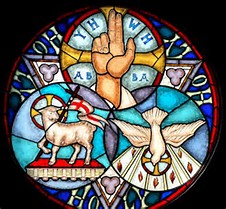
The concept of one God in three persons is a stumbling block for some, and a mystery for us all. We are human. We are finite beings, with limited understanding and imagination. Through all our coming and going, through all our activity, through our joy and our sorrow, God promises never to leave us alone. Instead, God’s loving refrain to us is, was, and always will be, “I’ve got you covered.”
Of course, as human beings, we struggle to understand or articulate who God is or how God functions. So, very early in the life of the church, our forefathers struggled to develop a common expression of what, based on the Scriptures and our own experience, we believe about the nature and function of God. The result of this work? Creeds that are still in use today. Through the creeds, these statements of faith, we confess what it is that we believe about the nature of God.
One of those is the Athanasian Creed, which some of you may remember. It was printed in our previous hymnal, the green one; it took up an entire page and a half. You won’t find it in the hymnal we currently use, since the Athanasian Creed has gone largely out of use in our churches. However, in some congregations it is still pulled out once every year - on this particular Sunday - and recited by the entire congregation, as an articulation of trinitarian belief.
Because I love you and see no need to punish you in that way, we’ll skip the Athanasian Creed today, except for this which comes directly from it: “Now this is the catholic faith: We worship one God in trinity and the Trinity in unity, neither confusing the persons nor dividing the divine being.”  
God in trinity…..Trinity in unity. As confusing as it is, those simple phrases contain the core of our faith – that our God comes to us as the glorious, mysterious three-in-one, and that through the Trinity, God says to us, “I’ve got you covered.”
So what is it that we believe about the three persons of the godhead? Each week when we come together we state our belief. On festival Sundays we use the more formal language and form of the Nicene Creed. But the more commonly known and recited Apostles’ creed is the one that we, together with Christians around the world, pray together week after week.
As the most common expression of faith, Martin Luther broke down the Apostles’ Creed for us in the Small Catechism, as a way to help families teach and learn what it is that we believe about God.
Recently, each family received a pocket-sized copy of Luther’s Small Catechism, which I’m sure you have with you, since you faithfully study it at every opportunity, right? Would please pull it out now, and we’ll take a look at the Apostle’s Creed together. What? You don’t have it? Ah!
Well, I’ve got you covered! In the back of each hymnal you will find the Small Catechism. If you’ll take out your hymnal and turn to page 1162 you will find the Apostles’ Creed. 
Luther breaks the creed down into three manageable articles, one devoted to each person of the Trinity. The first article is, “I believe in God, the Father almighty, creator of heaven and earth.”
Seems simple enough. Together, let’s read what Luther has to say about what that means:
I believe that God created me with all that exists. God has given me and still preserves my body and soul: eyes, ears, and all limbs and senses; reason and all mental faculties.
In addition, God daily and abundantly provides shoes and clothing, food and drink, house and farm, spouse and children, fields, livestock, and all property – along with all the necessities and nourishment for this body and life. God protects me against all danger and shields and preserves me from all evil. And all this is done out of pure, fatherly, and divine goodness and mercy, without any merit or worthiness of mine at all! For all of this I owe it to God to thank and praise, serve and obey him. This is most certainly true.
Wow – one simple sentence, but what it says about God is both more broad and complex than we might suspect at first.
The second article of the Apostles’ Creed reads: “I believe in Jesus Christ, God’s only Son, our Lord, who was conceived by the Holy Spirit, born of the virgin Mary, suffered under Pontius Pilate, was crucified, died, and was buried; he descended to the dead. On the third day he rose again; he ascended into heaven, he is seated at the right hand of the Father, and he will come to judge the living and the dead.”
Again, let’s read together how Martin Luther unpacked this statement: I believe that Jesus Christ, true God, begotten of the Father in eternity, and also a true human being, born of the virgin Mary, is my Lord. He has redeemed me, a lost and condemned human being. He has purchased and freed me from all sins, from death, and from the power of the devil, not with gold or silver but with his holy, precious blood and with his innocent suffering and death. He has done all this in order that I may belong to him, live under him n his kingdom, and serve him in eternal righteousness, innocence, and blessedness, just as he is risen from the dead and lives and rules eternally. This is most certainly true.
And finally, we have the third article, which describes the work of the Holy Spirit who, among other things, makes us holy: “I believe in the Holy Spirit, the holy catholic church, the communion of saints, the forgiveness of sins, the resurrection of the body, and the life everlasting.”
My friends, in the words of Martin Luther, “What does this mean?”
I believe that by my own understanding or strength I cannot believe in Jesus Christ my Lord or come to him, but instead the Holy Spirit has called me through the gospel, enlightened me with his gifts, made me holy and kept me in the true faith, just as he calls, gathers, enlightens, and makes holy the whole Christian church on earth and keeps it with Jesus Christ in the one common, true faith. Daily in this Christian church the Holy Spirit abundantly forgives all sins—mine and those of all believers. On the last day, the Holy Spirit will raise me and all the dead and will give to me and all believers in Christ eternal life. This is most certainly true.
These are the things we believe about who God is and how God works. Yet it is not even our belief here that matters, or the words we put together, but what God is doing that creates meaning and difference. All evidence points to the truth and makes it clear that through divine activity and care, God has us covered.
From the beginning of creation, through the exodus and the wilderness years, all through the history of our salvation to the sending of God’s own Son, Jesus, God has had us covered. As Jesus was preparing his disciples for life, mission and ministry following his resurrection, Jesus sends his disciples out, giving them authority to speak and work in his name, knowing that no matter what might befall them, “I’ve got you covered – always – to the end of the age.” And finally, through the Holy Spirit’s power and presence, God has us covered.
In our gospel text, Jesus gathers the disciples together and sends them out, blessing them and commanding that they bless and baptize others in the name of God – Father, Son and Holy Spirit.
In our Epistle reading, Paul aims to bring the Corinthians, those disagreeing, bickering, recalcitrant brothers and sisters of the early church into order, agreement, and peace – and invites them into knowing peace and unity by the sharing of a holy kiss. He reminds them that they, too, are church whose purpose it is to go out, in the name of Christ and with the blessing of Father, Son, and Holy Spirit – God’s own “I’ve got you covered.”
Our texts today emphasize how, from the beginning of our existence and beyond, God has had it all covered, creating in great detail all that would be needed to sustain life and make it beautiful. Redeeming it through the love of Christ, who passes on the mission to share and spread the word of God’s glory, majesty and care – God’s own “I’ve got you covered.”
As we read these texts all together on this Trinity Sunday, we are reminded that God’s love is evident in all the comings and goings of our lives, and that the blessing within each of these texts is ours.
In love, God has provided for our every need through the creation of the world, the salvation of our sins, and God’s ongoing presence in our lives through the abiding presence and work of the Holy Spirit.
It is hard as human beings to fully grasp the concept of Trinity – one God, three persons, equal in majesty, co-equal in eternity – as the Athanasian Creed would remind us. The important thing to remember is that despite our struggles to believe, to understand or even, sometimes to confess, through the means of grace, God truly does have us covered, empowers us to gather and then to go, never alone, to share God’s story of love with those we encounter. Thanks be to God!
Amen.