Search This Blog

Showing posts with label mission. Show all posts

Tuesday, June 20, 2017

A Gut Feeling


Matthew 9:35-10:4
During the sermon on Holy Trinity Sunday last week, we heard through text and sermon about how God’s activity through the Holy Trinity is God’s living out the divine promise of “I’ve got you covered.” The Trinity’s ongoing presence and work as Father, Son, and Holy Spirit functions to show us who God is and how God operates throughout the universe. We acknowledge that though the Trinity is a mystery, and we don’t fully understand exactly how it is possible, it is through in Trinity that God the Father, Son and Holy Spirit, has us uniquely covered – simultaneously creating, redeeming, and making us a holy people.
So, last week’s “I’ve got you covered” text and sermon addressed the how and what of God. This week’s gospel starts out by telling us the why of God. 
Today’s gospel text begins by telling us how Jesus went about the cities and villages – in other words, how he went to every type of people and every kind of community. Then, we come to verse 36 we read: “When he saw the crowds, he had compassion for them, because they were harassed and helpless, like sheep without a shepherd.”
Here we have it – this is the why of God. God has compassion.
In and through Jesus, God responds to our suffering out of compassion. Jesus brings God’s comforting Word, teaches people who need to hear that Word about the true nature of God, and heals their sicknesses out of compassion. But the thing is, this word as we read it here, compassion, is truly a watered-down version of what the word written in Greek really means.
So, for instance, when you hear the word, “compassion,” what do you think of? What does it mean? <accept responses> To feel for? To take pity on? To want to help?
Good answers. It’s a good start. Yet if you look at the etymology of the English word, compassion, it goes a little further; ‘compassion’ comes from the Latin cum, meaning ‘with’ and passio, meaning ‘suffering’. So, when we have compassion, we are suffering with another person, or feeling their suffering.
To go a step further,  we have the Greek word actually written into this text; splanknizo, or, in this case, splanknizomai, since it is in verb form, means to “feel in the viscera.” In plain English the closest way I can put that is, ‘to feel in the gut’ – to feel to your very core – to have a gut-wrenching reaction to something - to feel it so deeply in your insides, that you literally feel something within you move.
God sees the helplessness of God’s creation and God acts out of compassion. God doesn’t simply feel badly for the people who are suffering, God acts because God feels our pain and is moved to the very core by the plight of humankind. God knows how harassed – how out of sorts, beleaguered, and overwhelmed we are - how much we suffer from depression, oppression, and suppression; that is what affects God, moves God so much that God sends Jesus Christ to us as the Word incarnate, to heal our pain and brokenness, and save us from our sin.
That is the truest meaning of the word translated here, and it reason for God’s action; it is the reason that Jesus reaches out and heals and cures the people he encounters on his journey through the cities and towns and villages; through the city streets and along the country lanes through which he passes. Jesus doesn’t simply feel badly for the people, pity them or judge them as pitiable, rather, Jesus sees their humanity, and he is moved to ease their pain.
But Jesus cannot do this work alone, because he knows that one day, he will leave this earthly plane and will need workers to carry on the work he has begun. He will need apostles who will likewise speak the Word, teach, and heal.
So, in a touch of irony, Jesus summons these early disciples, and instructs them to ask the Lord of the harvest to send out laborers into the harvest.
Now, when I was in seminary, a very wise professor told us, “when you pray, be sure that you do not pray for something, for which you are not willing to be the answer.”
In the very next verse of our text today, Jesus calls twelve of these disciples and gives them the authority – read this as marching orders – to do the same as he has done. So, on the one hand, Jesus says, ‘pray for workers to help with the harvest’ – on the other hand he says, ‘now, you are to be first among those workers.’
Jesus calls his disciples – those who learn from him, not only to pray for the solution but to be part of the solution. And Jesus asks the same of us today, as community together with and for each other, and as harvest workers for the world around us. Jesus calls us to be moved to the very core of our being for the suffering ones – the harassed and helpless ones, the grieving and hurting ones, the hungry and homeless ones - and to respond; to reach out with compassion and heal those we encounter along our journey.
As the disciples go, they will proclaim the good news of the kingdom of heaven, and they will do this not for pay, nor for their own glory or benefit, but only for the sake the other, and the fullness of God’s kingdom.
I recently had a conversation with a woman who told me this story: she, along with her husband, had just joined a new church, but were not yet well known there, when an unbelievable tragedy befell their family. They were devastated, grieving, and suffering great pain and loss.
The incredible tragedy they had suffered was announced to the congregation in several forms of communication that went out, and members felt deeply sorry for anyone who would suffer such a loss, and they dutifully prayed for her family.
But what the woman told me was that not one person from that church called, sent a card, or reached out to her and her husband.
She and her husband had joined that church seeking to be part of a faith community. But perhaps because they weren’t all that well known yet, it seemed like the compassion of the members of the church was only skin-deep.
While prayer is very important, that family needed to know by the actions of their faith community that they were moved to the very core of their being by the pain and loss the family had suffered. Instead, the silence they experienced was deafening and only served to increase their pain; they felt betrayed and isolated by the community they thought would stand by them in their hour of need.
The result? The woman told me that though her faith in God was not shaken, her faith in the community of the church was shattered. They now felt it futile to belong to a church. What was the point? The community had failed them. The lesson for us all: our compassion needs to be more than skin-deep and it needs to be evident in our words and actions.
Whether the need comes from someone within the community itself or comes from one of our neighbors, Jesus calls us to know gut-wrenching compassion for those God places on our path and along our journey.
As a church, we’ve been doing a lot of talking about numbers. We talk about the numbers of people who come to worship. We talk about the numbers of people in the community around Easton whom we would like to bring into the body of Christ at Grace.
Jesus calls us to look past the numbers and see the people who are hurting, harassed and helpless. Jesus calls us to reach out to those in need of hearing the good news of God’s “I’ve got you covered” in a believable way – through our words and our actions. The best way to tell others about God is to show others about God, by modeling the love and compassion of God not only by what we say, but also by what we do.
The compassion of Jesus described in this text is a model for all of Christ’s disciples. Our text names those disciples whom Jesus sent out, even names some who failed him in some ways. Yet even in their failure, they have served the larger purposes of God.
In our baptism, we were each named as well. We were named children of God and workers in the new community to which we were joined, along with all the other laborers needed to serve the harvest of God.
The work is not easy. It is taxing. It is emotionally exhausting, it will not always be successful by our measures of success. But faithful service to God serves the larger purposes of God’s kingdom, to heal the hurts and feed the souls of those who most need to experience the love of God through the care and fellowship of the followers of Jesus.  It matters not whether we are able to discern “success” or not. We may never know the difference we have made in a person’s life – the reward is not ours to enjoy. But showing compassion through action in the name of Jesus Christ is our purpose in life and in this community for the ministry we share in God’s kingdom here on earth.  
Jesus sends us out in mission: to be the heart and guts of Christ for people. Jesus urges us to pray not only for our work but that more workers may join us, for the sake of the mission of God. Jesus models loving, compassionate caring that is more than skin-deep, but is demonstrated as well in faith through action.
Through the Holy Spirit, God grants us gifts of ministry for healing, and blesses us with the apostolic mission of the church. God grants us fellowship with all the workers who are sitting in the pews beside you here today, plus other workers who are sitting in pews in other churches hearing the good news of the compassion of Jesus and our commission to follow in his ways. This fellowship includes those who have yet to join us.
So today we go from “I’ve got you covered” to “Feeling it in the gut: the mission and ministry of Christ”. How does that work as a title for this message? It may not be very catchy, but it’s pointed. Christ’s love and presence are real, and he calls for ours to be, as well. May God, Father, Son and Holy Spirit, grant that it may be so.
Amen.


Monday, April 10, 2017

Parade of Difference


Palm Sunday 2017
That first Palm Sunday – was a raucous time in the city of Jerusalem. It was to be expected. After all, it was the beginning of the Festival of the Passover, when religious pilgrims cause the city’s population of roughly 60,000 to 70,000, to swell by 200,000 or more people, all there to commemorate and celebrate Israel’s defining moment, her liberation from Egypt at the original Passover, almost 1300 years before.
After all, this is the reason that Jesus and his disciples are there as well. They have traveled to Jerusalem, as Jesus has done every year for his entire life, for this religious festival.
Yet this year, on this day, something is different. Jesus enters Jerusalem, his ultimate mission fully on his mind. He knows that the end is coming for his earthly journey; this part of his story is coming to a climax. Jesus enters Jerusalem knowing that this time, he will not leave the city alive. Events have transpired, powers have been placed in motion, that will lead to his passion and death this week--And in eight days’ time, to the defining moment for all of us, his startling resurrection.
In eight days’ time, Jesus will achieve his ultimate victory over powers of evil and death as the stone is rolled away from his tomb and he defies the bonds of both earthly and supernatural power. But for now – the procession.
Being the first day of the Festival, there is not one but instead are three distinct processions that enter Jerusalem that day. These are the parades of contrast that I would like to talk about today.
First, of course, comes Jesus. Jesus enters Jerusalem through the east gate of the city – the gate through which the tradition of the People of Israel has always said the Anointed One, the Messiah, will enter Jerusalem.
Through the east gate Jesus enters the city on the back of a donkey as the people shout, “Hosanna!” which literally means, “save us now”. Then they add, “Blessed is he who comes in the name of the Lord!” This proclamation comes from Psalm 118, a psalm traditionally recited by Jews at two important times each year – it is recited at the Feast of the Tabernacle, and at the Feast of Passover. It recalls the way kings historically were welcomed back to Jerusalem as they returned victorious from wars.
  And as Jesus rode down from the Mount of Olives, the people waved palm branches – indicative of a festal procession, a sign of victory and celebration for Jews and Romans alike.
Palm Sunday 16 by Bernard Plockhorst
But this psalm was also understood to refer to the Messiah, the Anointed One who would come and deliver his people. In using these verses to exclaim their fealty to Jesus that day, the people were in fact hailing Jesus as their king, and declaring this as his royal procession.
At the same time as all this was taking place, on the opposite side of the city, entering the city from the west came Pontius Pilate, the Roman governor of Judea, coming from Caesarea by the Sea, and bringing with him an entourage of at least 1,000 heavily armed Roman soldiers who would either be riding on horseback or chariot, or walking on foot. This procession was designed as a show of force; it was intended for the sole purpose of reminding the people gathered in the city of who was in control.
Lest any group conspire or think about raising up a rebellion, the message was clear: don’t. Don’t even think about it. You will be crushed. With all the extra people gathered for a festival that marked Jewish release from bondage in Egypt, it seemed like a good time to remind any who might be carried away by the hopeful undertone of the festival of the Passover that Rome was in charge. To drive this point home, it was Pilate’s intention to crucify several rebels on Thursday that week—just in time for the Passover. 
The third procession to enter the city, this time from the north with his own followers and royal soldiers was King Herod Antipas, who ruled over Galilee and Perea to the north and east of Judea. Like Pilate, Herod knew how to use violence to suppress rebellion and to express his power and authority over the people. And as he entered the city, his supporters lined the streets, cheering as he arrived.
There was good reason for any Jerusalemites in power or high status or wealth to support and cheer for this king – they were well aware that he had the power to strip them of everything they had if they displeased him, even to the point of exiling them or executing them if he desired to do so. Currying favor with the king was important to the livelihood of many of the residents of Jerusalem that day.
Three processions, for three distinct purposes. The contrasts between Jesus’ historic Palm Sunday procession and the parades of Pilate and Herod are striking. Pilate and Herod enter on warhorses, not unlike the victorious procession of Alexander the Great in 332 B.C. when Jerusalem capitulated to him as he entered the city on his way from Tyre to Egypt during the Macedonian conquest. They are preceded and surrounded by heavily armed companies of soldiers. Their processions epitomize military might and muscle. Against Pilate’s and Herod’s armies, Jesus’ poor and ordinary provisions stand out:
He has no herald at arms; no trumpets sound; no chariots of state precede him into the city; there are no liveries that follow. None in his procession carry weapons – only palms. There are no prancing horses or running horses that would create a distance between Jesus and the people, or force away a needful one who came to appeal to Jesus for help.
Rather, Jesus rides into Jerusalem on a quiet ass, the mightiest king coming in the most humble of means.
Two of the three men entering Jerusalem on that Festival Sunday were iron-fisted men known for their cruelty. The third is Jesus, known for his healing and mercy.
Two ride war-horses, while Jesus rides on the back of not just a donkey, but the foal of a donkey.
Two are carrying weapons of war, surrounded by military power, exuding the authority vested in them by the state of Rome; Jesus rides in humility, making his royal claim, with every choice declaring that he is the Anointed One, the Messiah, sent by God, proclaiming God’s love. His weapons are forgiveness, grace and mercy; his authority is divine; it comes from God above.
We can compare and contrast all the differences between these three today, and what we will find is that it all boils down to this: Jesus will give the world what the Herods and Pilates of the world never can – eternal life and peace, and a way forward that leads to justice and joy.
And as the processions enter the city something happens. They don’t cross paths, they don’t engage in a show of force or conflict, in the moment they likely not even aware of the presence of the others. But as Jesus enters Jerusalem even as Pilate and Herod enter the city through opposing gates, the earth shakes.
Quakes are mentioned only three times in this gospel: now, at Jesus’ entry into Jerusalem, at the time of his crucifixion as our King bows his head and dies, and on Sunday a week hence, when he rises from the tomb, his resurrection illustrating the true power and victory of our Lord and Savior. It is as if the spiritual energies that collide and clash here cannot be contained. Even the earth and the heavens bear witness to the majesty of Jesus and to the ultimate power and authority that are his to command.
As we contemplate the contrasting processions of that first Palm Sunday, we are invited to our own commemoration of the Festival of our Passover, where Jesus serves as the Lamb of God, come to take away the sin of the world. We are invited into a week that changed the world.
We are ushered into the story and remain as bystanders and witnesses when Jesus seals his fate by cleansing the Temple and declaring that God’s house will be a holy house of prayer where all are welcome – Jew and Gentile, insider and outside, rich and poor, outcast and sinner, and where all will be healed by the power of a God so merciful, so gracious and righteous, that he redefines the Passover, redefines salvation itself, blessing us with the gift and reality of everlasting life.
You and I, my friends, are among the multitude of souls who are invited into a week brimming with death and life and life after death for all who believe in God’s power and authority over every element on earth. This is God’s gift to us. This is our reality. This is our story. We are invited to walk in the footsteps of Jesus, to receive blessing and absolution for our sins, to be fed and nurtured in the faith, to be cleansed for service in Jesus’ name, and to be witnesses of the great and glorious power of God to save. May we all be blessed to know these truths as we embrace the Passion and Cross of Christ in these days.
I urge you to accept this invitation. Immerse yourself in the greatest story ever to unfold, and all for the sake of humankind, for the sake of the kingdom of God. Then and only then in eight days, will we be ready to embrace and to receive the glory of the resurrected Christ. Amen.


Saturday, January 23, 2016

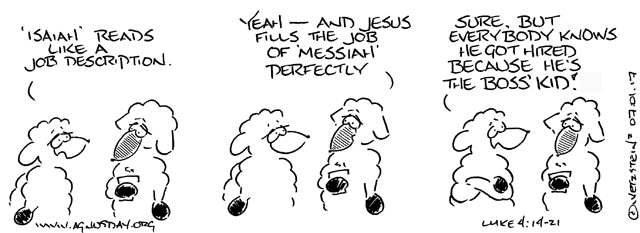
Jesus and the Job Description

Luke 4.14-21
We are purpose – driven creatures. It has long been understood that people with a solid sense of purpose are generally healthier, happier, and more content in life. Knowing what our purpose, mission, or call is buoys our spirit, provides a focus for our energy and creates pathways for connections with others who have a similar sense of purpose.
Agnus Day lectionary strip
In our gospel lesson for the Third Sunday After Epiphany, the gospel text tells us that as he was attending synagogue in Nazareth, his hometown, Jesus was handed the Isaiah scroll and from it he read, “The Spirit of the Lord is upon me, because he has anointed me to bring good news to the poor. He has sent me to proclaim release to the captives and recovery of sight to the blind, and to let the oppressed go free, to proclaim the year of the LORD’s favor.” Upon handing the scroll back to the attendant, our text continues, reporting that Jesus said to those gathered around in the synagogue, in the holiest of places, “Today this scripture has been fulfilled in your hearing.”
In this text, Jesus is a) once again, announcing and confirming that he is the Messiah, and b) announcing his central purpose in life and in ministry: to proclaim good news to the poor, etc. and c) proclaiming that the promised liberating work of the Spirit of God is now present in him.
We might argue whether “the poor” he was referring to were those who were starving, homeless, or destitute – the ones who are economically poor, in other words. Or, we might interpret the poor to mean those who are spiritually poor – those who have little understanding of the presence of God in their lives and the love that God holds for them. Perhaps “the poor” to us are all of the rest of those who live on the margins – the addict, those suffering from chronic or terminal illness, those who, because of race, gender, sexual identity, religion, nationality, ethnicity, age, IQ level, or you might have your own definition of who the “poor” are in our society and in our world.
We will discover in next week’s text, which is the continuation of this story, how the people reacted to what Jesus was saying. But for today, let us consider these questions:
  1. 1

    .      
    Who do you think of when you hear “the poor?” Do you ever consider any of those (aside from the economically poor) listed above?
  2. 2.       If you were to think more expansively, who might we add to a list of “the poor” – who do we overlook when we refer to those who are poor, in need of liberation or attention?
  3. 3.       What is your understanding of the Christian mission or purpose?
  4. 4.       How do you think Grace is living out her Christian mission, and what more do you think God is calling us to?
  5. 5.       What is the good news for you and for me in this text?

In choosing this passage to read, Jesus is announcing his purpose may be summed up as prophet, Messiah, healer, liberator. In the gospel of Luke what we see Jesus doing over and over again is consciously working toward the fulfillment of the purpose he states here: to heal the brokenhearted and the blind, announce release to the prisoners, and reveal that God's compassionate, loving Spirit is loose in the world.
The big question for us is, What difference does this news make in our lives? What new sense of purpose does it give us? How does this text reflect on the Church’s mission and sense of purpose and how might it guide our actions, decisions, worship, prayer, and planning?
Let us each pray on these questions and seek the answers God has placed before us, and weighing how we might respond.


Wednesday, September 9, 2015

Skip the Whitewashing - Let's Paint With Color

Mark 7:24-37
How often we strive to soften the edges of what we find uncomfortable.
I wonder: Have you ever found yourself trying to fix a story that casts someone you care about in a somewhat unflattering light? You describe the person in favorable terms, you paint them in glowing colors, you emphasize or even exaggerate their positive attributes, while minimizing their faults or ignoring them altogether.
Have you ever rearranged the details of a story to make the main actor – whether it is you or someone you know – a bit more sympathetic, a bit more palatable?
In Martin Luther’s explanation to the 8th commandment, the one about bearing false witness, Luther goes on to explain the spirit of the commandment this way: “we are to come to (our neighbor’s) defense, speak well of our neighbor, and interpret everything they do in the best possible light.”
The Woman of Canaan by Michael Angelo Immenraet,
 17th century
Well, if Martin Luther said it, then we must be on the right track when we whitewash certain – let us say – aspects of a person’s behavior – especially when that person is Jesus.
That is what we often do when we read gospel texts like the one we read this morning. We interpret Jesus’ shocking words and reaction to the Syrophoenician mother’s request in the best light possible.
By “dogs” surely Jesus was referring to cute little puppies, not to the fact that the woman was a Gentile nor suggesting that she was a morally inferior person.
Or, we make excuses for Jesus. He’s been traveling a lot. Surely, he’s hot and tired. After all Mark makes sure we know that Jesus was wanting to have some quiet time. Some down time, perhaps. He didn’t want anyone to know he was there in that house. So, the woman caught him at a bad time, in a bad place. Surely, cranky Jesus just needs a nap. He is human after all.
Better yet, we translate Jesus’ brush off as a test. It’s intentional. It is a teaching stratagem. Jesus was simply testing the woman and doing so in such a way as to pass along to his disciples something about the importance of faith, maybe even persistence in faith.
Jesus is the great teacher, after all. And that’s what teachers do. They teach; on the clock, and off the clock. As for the woman, it seems she passes the test.
Maybe all of these things do play a role in the emotional state of Jesus and in his response to the woman’s request. But I wonder if we don’t actually miss something important when we sweep this story and cranky Jesus under the rug.
Because frankly, while all of those explanations may serve to help us feel better about the words Jesus uses, no matter how you slice it, this story is still hard to understand and uncomfortable to read. It’s like a hunk of bread stuck in the throat, - a hunk that just doesn’t seem to want to go down.
Why is it that in that house in Tyre that day, Jesus seems so unkind, so dismissive, so discriminatory?
We are living in an age where we are particularly sensitive to the kind of name-calling we see here, - as well we should be. So a red flag goes up. We disparage this kind of derogatory labeling, we condemn it as just not acceptable. And we know about such labeling.
Truth be told we’ve probably engaged in it ourselves, whether in thought, word, or deed.
But lately, derogatory names, images and ideologies have become flash points for angry protest in our politically correct world. Think about all the signs of protest that have surrounded us lately:  #Blacklivesmatter; #alllivesmatter; #equalopportunityforall; and this one that I saw yesterday, “treating refugees as the problem is the problem.”
So, trying to make sense of Jesus referring to a desperate mother who comes to him pleading for relief from suffering for her young daughter as a dog is confusing and disconcerting.
Is it possible that Jesus himself really just had a lesson to learn, and that this woman helped him learn it?
My friends, context matters.
The gospel of Mark has been illustrating the tension building as background is laid for Jesus’ ministry, revealing, bit by bit, “God’s kingdom has been inaugurated, but is not yet fully realized…” Perhaps even Jesus himself does not yet fully understand the extent and radical nature of the kingdom he proclaims, which is nothing less than God’s far-reaching plan for history.
Jesus lives in a land that is deeply divided, where fellowship between Jews and Gentiles historically has been forbidden; where historically, the Jews of Gallilee have been oppressed and subjugated by foreign powers, even powers from the region of Tyre. Wheat from the Galilean fields, produced from the hard labor of Galilean farmers makes the bread that fills the baskets that sit on the tables of prosperous Tyreans, while many Jewish peasants go hungry.
As he tries to rest in the house in Tyre, a house which sits in Gentile territory, perhaps Jesus himself is still learning something that the woman pleads for and hopes for – that the mercies of God extend even now beyond the boundaries of ethnic Israel.
As we have collected the stories early in the gospel of Mark, they illustrate the growth of Jesus’ ministry – his authority in teaching and preaching being questioned and affirmed; all those miracles Jesus has performed – healing, casting out unclean spirits and demons; his feeding thousands of people with just a couple of    fish and a handful of loaves of bread; his walking on water - and we have grown in our understanding of Jesus as the Son of Man who has come into this world to transform lives and hearts.
Now it seems that Jesus’ mission must break down the boundaries observed throughout the centuries between God’s Chosen people of Israel, and the Gentiles.
In an episode just before this story, Jesus articulates a reorientation of the religious law and traditions, as he and his disciples argued with the Pharisees over the ceremonial practices and the social mores surrounding the consumption of food – mores that in fact create separation.
Jesus said that it is not what is on the outside of a person that defiles them but what is on the inside. What is in the heart of a person is then what really counts and is made evidence by their actions, the words they say – the things they do.
We don’t know what the woman thought about her own worthiness of God’s attention or Jesus’ time. But she demonstrated through her actions, absolute conviction that her beloved daughter was deserving of Jesus’ healing.
Whatever Jesus may have meant by his initial response to her in today’s gospel text, we know that one way to disarm criticism is to agree with the critic.
So the woman doesn’t express outrage at Jesus’ statement, nor does she argue with him. "I am a dog,” she agrees, “but even the dogs eat the crumbs that fall from their masters table."  In other words, perhaps, "I know I don't deserve a thing from you. I am no better than a dog in your world, but even dogs receive better treatment than you're giving me. Can't you spare a few crumbs of grace? I'm not asking for myself, but for my daughter."
This woman may not fully understand the nature of Jesus’ mission either, but for herself – for her daughter - her hope and her trust in Jesus is all she has and all that matters. And with a word, Jesus performs the healing she requests.
The change this encounter provoked within Jesus calls us to reflect on the power our own encounters with people who are ‘other’ can have on our own understanding of the Kingdom of God and who it includes. This woman teaches us about the power—and influence— encounters with strangers, ‘foreigners’, and newcomers can have. They can influence our own understanding of the limitlessness of God’s grace.
Folks we don’t yet know, people from different walks of life and backgrounds, and peoples of all nations have the ability to stretch our perspective, and teach us about ourselves, themselves, the world, and God. Jesus himself shows us the way to allowing our hearts and our actions be softened and swayed by the hope and the need of strangers.
We remember that each and every person on this earth, even those we don’t yet know, are created in God’s image, and therefore bear God’s image in the world.
While Jesus may have a change of heart in an instant, our hearts—at least my heart—tends to need a bit more work.
But, it is my hope, my trust, my experience, and God’s promise, that our encounters with the Gospel, and with Gospel-bearers who come to us as “the other”, do change us, little by little, more and more into Christ’s likeness.
Just as Jesus was changed by His encounter with the Syrophoenician woman, by the grace of God, these encounters with “the other” teach us about the radical nature of God’s love and grace.         
The Gospel is more than just a whitewashed image of Jesus as God’s promise to makes us feel better: The Gospel is an encounter that changes. It is the living Word of God through which God blesses us.
Through it and through the strangers and neighbors who challenge us by their otherness, may God grant us eyes, hearts, and minds open to transformation, that, more and more, we may understand and live the radical nature of God’s Kingdom, as we share God’s Good News of love and grace with all the world.