Search This Blog

Tuesday, June 13, 2017

I’ve Got You Covered


Holy Trinity Sunday
Genesis 1:1-2, 4a; 2 Corinthians 13:11-13; Matthew 28:16-20


            I have a couple of riddles for you:
What did the rug say to the floor? “I’ve got you covered!”
What did George say to his friend Joe when the check for their meal arrived and Joe realized he didn’t have his wallet? “Don’t worry. I’ve got you covered!”
What did the police detective say to her partner before she advanced toward the suspect’s door? “I’ve got you covered.”
God’s message to us this day and always is, I’ve got you covered.  And on Trinity Sunday, we marvel in all the ways that our creating, redeeming, sanctifying God says to us, I’ve got you covered.
God has us covered through God’s creative activity where God creates the world around us in an ongoing dynamic and dramatic creation story. God’s creation includes every bird, bee, cloud, person, drop of water, mountain, sea, and so on.
God has us covered through the grace we receive, a free gift through the redeeming work of Jesus, our Lord and savior who continues to teach us through God’s Word, strengthen us through his body and blood as he comes to us in Holy Communion, and forgives our sins daily through the ongoing work of the cross.
And God has us covered through the Holy Spirit, the one who gathers us here together, who grants us faith and vision, and inspires and enlightens our path.
The concept of one God in three persons is a stumbling block for some, and a mystery for us all. We are human. We are finite beings, with limited understanding and imagination. Through all our coming and going, through all our activity, through our joy and our sorrow, God promises never to leave us alone. Instead, God’s loving refrain to us is, was, and always will be, “I’ve got you covered.”
Of course, as human beings, we struggle to understand or articulate who God is or how God functions. So, very early in the life of the church, our forefathers struggled to develop a common expression of what, based on the Scriptures and our own experience, we believe about the nature and function of God. The result of this work? Creeds that are still in use today. Through the creeds, these statements of faith, we confess what it is that we believe about the nature of God.
One of those is the Athanasian Creed, which some of you may remember. It was printed in our previous hymnal, the green one; it took up an entire page and a half. You won’t find it in the hymnal we currently use, since the Athanasian Creed has gone largely out of use in our churches. However, in some congregations it is still pulled out once every year - on this particular Sunday - and recited by the entire congregation, as an articulation of trinitarian belief.
Because I love you and see no need to punish you in that way, we’ll skip the Athanasian Creed today, except for this which comes directly from it: “Now this is the catholic faith: We worship one God in trinity and the Trinity in unity, neither confusing the persons nor dividing the divine being.”  
God in trinity…..Trinity in unity. As confusing as it is, those simple phrases contain the core of our faith – that our God comes to us as the glorious, mysterious three-in-one, and that through the Trinity, God says to us, “I’ve got you covered.”
So what is it that we believe about the three persons of the godhead? Each week when we come together we state our belief. On festival Sundays we use the more formal language and form of the Nicene Creed. But the more commonly known and recited Apostles’ creed is the one that we, together with Christians around the world, pray together week after week.
As the most common expression of faith, Martin Luther broke down the Apostles’ Creed for us in the Small Catechism, as a way to help families teach and learn what it is that we believe about God.
Recently, each family received a pocket-sized copy of Luther’s Small Catechism, which I’m sure you have with you, since you faithfully study it at every opportunity, right? Would please pull it out now, and we’ll take a look at the Apostle’s Creed together. What? You don’t have it? Ah!
Well, I’ve got you covered! In the back of each hymnal you will find the Small Catechism. If you’ll take out your hymnal and turn to page 1162 you will find the Apostles’ Creed. 
Luther breaks the creed down into three manageable articles, one devoted to each person of the Trinity. The first article is, “I believe in God, the Father almighty, creator of heaven and earth.”
Seems simple enough. Together, let’s read what Luther has to say about what that means:
I believe that God created me with all that exists. God has given me and still preserves my body and soul: eyes, ears, and all limbs and senses; reason and all mental faculties.
In addition, God daily and abundantly provides shoes and clothing, food and drink, house and farm, spouse and children, fields, livestock, and all property – along with all the necessities and nourishment for this body and life. God protects me against all danger and shields and preserves me from all evil. And all this is done out of pure, fatherly, and divine goodness and mercy, without any merit or worthiness of mine at all! For all of this I owe it to God to thank and praise, serve and obey him. This is most certainly true.
Wow – one simple sentence, but what it says about God is both more broad and complex than we might suspect at first.
The second article of the Apostles’ Creed reads: “I believe in Jesus Christ, God’s only Son, our Lord, who was conceived by the Holy Spirit, born of the virgin Mary, suffered under Pontius Pilate, was crucified, died, and was buried; he descended to the dead. On the third day he rose again; he ascended into heaven, he is seated at the right hand of the Father, and he will come to judge the living and the dead.”
Again, let’s read together how Martin Luther unpacked this statement: I believe that Jesus Christ, true God, begotten of the Father in eternity, and also a true human being, born of the virgin Mary, is my Lord. He has redeemed me, a lost and condemned human being. He has purchased and freed me from all sins, from death, and from the power of the devil, not with gold or silver but with his holy, precious blood and with his innocent suffering and death. He has done all this in order that I may belong to him, live under him n his kingdom, and serve him in eternal righteousness, innocence, and blessedness, just as he is risen from the dead and lives and rules eternally. This is most certainly true.
And finally, we have the third article, which describes the work of the Holy Spirit who, among other things, makes us holy: “I believe in the Holy Spirit, the holy catholic church, the communion of saints, the forgiveness of sins, the resurrection of the body, and the life everlasting.”
My friends, in the words of Martin Luther, “What does this mean?”
I believe that by my own understanding or strength I cannot believe in Jesus Christ my Lord or come to him, but instead the Holy Spirit has called me through the gospel, enlightened me with his gifts, made me holy and kept me in the true faith, just as he calls, gathers, enlightens, and makes holy the whole Christian church on earth and keeps it with Jesus Christ in the one common, true faith. Daily in this Christian church the Holy Spirit abundantly forgives all sins—mine and those of all believers. On the last day, the Holy Spirit will raise me and all the dead and will give to me and all believers in Christ eternal life. This is most certainly true.
These are the things we believe about who God is and how God works. Yet it is not even our belief here that matters, or the words we put together, but what God is doing that creates meaning and difference. All evidence points to the truth and makes it clear that through divine activity and care, God has us covered.
From the beginning of creation, through the exodus and the wilderness years, all through the history of our salvation to the sending of God’s own Son, Jesus, God has had us covered. As Jesus was preparing his disciples for life, mission and ministry following his resurrection, Jesus sends his disciples out, giving them authority to speak and work in his name, knowing that no matter what might befall them, “I’ve got you covered – always – to the end of the age.” And finally, through the Holy Spirit’s power and presence, God has us covered.
In our gospel text, Jesus gathers the disciples together and sends them out, blessing them and commanding that they bless and baptize others in the name of God – Father, Son and Holy Spirit.
In our Epistle reading, Paul aims to bring the Corinthians, those disagreeing, bickering, recalcitrant brothers and sisters of the early church into order, agreement, and peace – and invites them into knowing peace and unity by the sharing of a holy kiss. He reminds them that they, too, are church whose purpose it is to go out, in the name of Christ and with the blessing of Father, Son, and Holy Spirit – God’s own “I’ve got you covered.”
Our texts today emphasize how, from the beginning of our existence and beyond, God has had it all covered, creating in great detail all that would be needed to sustain life and make it beautiful. Redeeming it through the love of Christ, who passes on the mission to share and spread the word of God’s glory, majesty and care – God’s own “I’ve got you covered.”
As we read these texts all together on this Trinity Sunday, we are reminded that God’s love is evident in all the comings and goings of our lives, and that the blessing within each of these texts is ours.
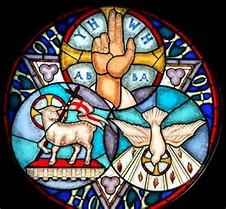
In love, God has provided for our every need through the creation of the world, the salvation of our sins, and God’s ongoing presence in our lives through the abiding presence and work of the Holy Spirit.
It is hard as human beings to fully grasp the concept of Trinity – one God, three persons, equal in majesty, co-equal in eternity – as the Athanasian Creed would remind us. The important thing to remember is that despite our struggles to believe, to understand or even, sometimes to confess, through the means of grace, God truly does have us covered, empowers us to gather and then to go, never alone, to share God’s story of love with those we encounter. Thanks be to God!
Amen.

Tuesday, May 30, 2017

Overhearing Jesus' Prayer


7th Sunday of Easter 2017
John 17:1-11; 1 Peter 4:12-14, 5:6-11

Sometimes, things we say are meant to be overheard by others. 
 
I think of the times when my children were small, and I would walk into a room and begin talking not to my child, but with the full expectation and intention that they would overhear me:
·         “Where is Billy? I can’t find him anywhere – he must have left the house! We had better send a search party to find him!” I knew of course that Billy was hiding safely behind the drapes, the toes of his sneakers poking out from beneath the fabric. I meant for him to hear me. Another example from those days:
·         “I think I heard noise coming from upstairs, but I am sure that can’t be any of our children! Because they know what’s good for them, so I know that when I go up there right now, I am going to find everyone sound asleep in their beds!” Again I spoke, intending for them to hear me, and hoping they got the message!
In our gospel lesson today, it is Jesus himself who speaks, intending his followers to overhear what he says and what he prays – to get the message.
As the time grows close for Jesus to be arrested and taken away, Jesus appeals to God on behalf of all those who will follow him, who will carry on in his name after he is gone. And so, on the occasion of Jesus’s last evening with his disciples, Jesus engages in what has been called a “heavenly family conversation” between himself and God.
We only hear one-half of this conversation between the Father and the Son, a conversation in which Jesus repeats what he has already told his disciples – that he will soon be leaving them; that he will be returning to his father in heaven; yet he will continue to love these whom he leaves behind, and he will not leave them either unprepared nor alone.
  His meant-to-be-overheard communication with God is a message full of hope, love, promise and truth for his followers. Jesus reveals those things that are closest to his heart – his care and concern for them, his love for them, and his determination that they continue to be united in belief and purpose. Not only united with one another but most assuredly, united with him.
Despite what they will soon witness and endure, through this prayer, Jesus wants his disciples to believe that God will be with them, working on their behalf.
Jesus repeats what he has already told them, just as a good parent repeats ad nauseum the messages their children need to remember for a good life or for safety: you are loved; you are worthy; work hard; tell the truth; be honest in all your doings; wear your seat


belt.
Jesus will soon be leaving his disciples, but they will never be left alone, because God has ensured that after Jesus has been “glorified on the cross” and returns to his father in heaven, an advocate, his own Holy Spirit, will continue to protect, teach, guide, strengthen and inspire them.
So on this pivotal night, Jesus, who has so often modeled prayer for his disciples gives them this gift of overheard prayer.
His previous prayers to God have often been for guidance or strength for himself, but here is a wonderful example of intercessory prayer: Jesus prays for them, for us, for all who will follow.  
Despite all the other things that must have been taking up head-space for Jesus that night, his thoughts and concerns were for those he was leaving behind: “I am asking on their behalf,” he says. “I am not asking on behalf of the world, but on behalf of those whom you gave me because they are yours.” What a beautiful gift!
Intercessory prayer is powerful. It is pure gift and blessing for those who pray and for those being prayed for. How often have you heard someone say that knowing someone was praying for them helped them through a difficult situation? It happens all the time. Maybe it’s even been your own experience.
It is not unusual when I visit with someone who has been going through a difficult time of illness or loss, and tell them that the congregation has been praying for them and in fact we had prayed for them together, aloud, during worship, the response I receive is that in some way the person felt the prayer, and that it made all the difference.
So, what does it feel like, today, to know that Jesus is praying for you? What difference does it make in your life that not only are you being prayed for, but that our Lord Jesus is one who is doing the praying, and that the Holy spirit prays for you, in sighs too deep for words? How does it feel to know that no matter what your circumstance, Jesus knows it well and intercedes for you? How does it impact the work that we do in the name of Our Lord, to overhear this prayer and know that Jesus prays for this community?
There are many things for which Jesus prays on our behalf. Jesus prays for peace. On that night, Jesus prayed that people might continue to know God through knowing him, even after he would be gone from their sight.
Jesus prays for the healing of the world. And in today’s gospel text, Jesus prays specifically that these brothers and sisters, who believe in God and have become disciples of Jesus, will continue in relationship with the God and with one another, following the way of Christ.
Finally, Jesus prays for the unity of those who believe in him. He prays for those who will continue in his ministry, the ones who will share his name as he himself shares in the name of God. Jesus prays that we will be one.  
At the beginning of worship this morning, we remembered and gave thanks for Baptism. In a few moments, as we receive new members into our congregation, we once again recall and affirm that we believe in Jesus Christ, the Son of God, and that this faith, a gift given to us, binds us together and makes us one.
We will confess how, through water and the Word, through prayer and meal, the Holy Spirit draws us together, the Body of Christ in the Priesthood of all believers, and those for whom Jesus prays this prayer.
As Jesus brings us together he blesses us with different gifts, and joins us as one despite our different backgrounds and varied stories.  At the table, Jesus feeds us as disciples and apostles, joined together through the grace of God, and trusting more in the power of the Holy Spirit than in human willpower. “Protect them,” Jesus prays, so that they may be one as we are one.”
Think of all the significant and silly differences we experience in our life together – debates about war and peace, human sexuality, economic justice, the color of the carpet in the chancel, whether we worship God in one service or two. In every age, people have chosen to remove themselves from community over these and other matters. But Jesus prays for us – “may they be one as we are one.”
Think of all the not-so-silly struggles and challenges that the followers of Jesus face. The letter from 1 Peter is a reminder that there are many struggles that we will encounter. The apostle in fact calls this the fiery ordeal that confronts us coming from the world within and around us.
This week once again in very stark circumstances, Christians in Egypt were targeted for violence and death. We look around and we fear death of another kind may one day face our community as we see shrinking numbers in worship and experience a loss of cultural support and respect for religion.
In the prayer of the day today, we expressed the same kind of yearning reflected in Jesus’ prayer: “Unite us with Christ and each other in suffering and in joy, that all the world may be drawn into your bountiful presence.”
How powerful it is to know that Jesus has prayed to God on our behalf! There is no one for whom Jesus did not pray on that last night. Like the prayer of a parent overheard by the child for whom one intercedes, what this prayer reveals, is Jesus’ deep love for us all.
The great prayer contained in this gospel text today evokes longing in us to be fully “one” with Jesus, in the mystical communion of prayer so that his prayer of love for us becomes not a farewell but rather a homecoming.
Jesus prays that his followers, as diverse as we are will be one, not that they will all be the same. Unity is not the same as uniformity.
Our diversity of background and thought brings beauty to the tapestry of our faith communities. Finally, Jesus demonstrates, through this overheard message, what it means to cast all our concerns on God, because God indeed cares for us.
So here is the thing, and I look to the second reading for this where, the seventh verse reads, “Cast all your anxiety on him, because he cares for you.” I think that along with the assurance that he himself cares and is constantly advocating for us, this is part of Jesus’ message to us as well.
When Jesus was troubled, what did you do? Pray. When Jesus was thankful, what did he do? Pray. When Jesus was weary, or frightened, or tired, he prayed. And when Jesus was preparing to leave his disciples to go to the cross, he showed them what it meant to cast all his concerns, all his anxiety, all his desires on God, knowing how much God cares for us all.
It’s a good message for the disciples. It is an essential message to us today. Whatever troubles you, whatever gives you joy, whatever it is that you need to be united as one with God’s purpose and in God’s love, trust the faithfulness of God, who loved us into being, to love you with the power that is God’s alone.
Amen.

Sunday, May 14, 2017

Someone with a little skin on

John 14:1-14
One night, a little girl, Lisa, we’ll call her - lay in her bed as storm clouds gathered outside. Soon, there was a full-blown thunderstorm going on right outside the windows of her bedroom. Thunder crashed and blinding flashes of lightening lit up her bedroom over, and over again.  Little Lisa was frightened. She cried out to her dad, who was in the next room, "Help me."
Immediately, she heard his voice respond, "Honey, God loves you and will take care of you."
Another bolt of lightning and clap of thunder caused Lisa to cry out again, "Daddy!" Again, she heard her father’s voice, "Honey, God loves you and will take care of you."
The storm continued to rage and Lisa, now frightened nearly out of her wits, called out yet again; her father's response was the same. But the little girl replied, "Daddy, I know that God loves me, but right now, I need someone with skin on."
Don’t we know that feeling?
Isn’t that sometimes our experience? I know God loves me, but right now, I need someone with skin on.  When we go through the struggles of life, when we have questions about why losses and difficulties and troubling things come our way, we need someone with skin on.
When we are frightened because the storm has gotten way out of hand and we are facing illness or joblessness or changes in our relationships, even betrayals; when the well-planned future we had counted on shifts and changes and when circumstances out of our control threaten the security we worked so hard to build, we want someone with skin on.
When Jesus came to be born in Bethlehem, he came as God with skin on. As he lived his life as one who was at the same time both fully human and fully divine; as he gathered disciples, ministered, healed, preached and taught his followers, he was, in fact, God-with-us – with skin on.
That is what we call the Incarnation; that in Jesus Christ, God became flesh. Jesus was that “someone with skin on.”
The conversation depicted in today’s gospel lesson took place on the night in which Jesus was to be handed over to the Roman officials. It is his last opportunity, the last word that he can give to his disciples before he leave this mortal plane, and he wants to make clear to his disciples that he is indeed, God with skin on.
In the days and weeks and years to come, Jesus knows that it is essential for them to continue believing that in him, God has come into the world and that God’s physical presence with them, while about to change in substance, will not change in reality.
Believing in Jesus we come to know that one true God – the one who is at once creating and redeeming; the one who transforms us in love; the one who promises never to leave us, but to abide with us forever. And that is a promise that stands – forever.
Jesus is not just “like” God; Jesus is the embodiment of the one true God. Through his life and his teachings he has shown his followers the full-bodied character of God – forgiving, healing, subversive, despising evil, loving good, inclusive, transforming, peace-loving, and possessing power over life; he is God with skin on, and even after his death he showed his disciples that he lives.
In his post-resurrection appearances, Jesus continues to be God-with-us – our God with skin on. As the fully human incarnation, Jesus died on the cross. This was not a theoretical death or an imaginary death. It was a real death, preceded by unimaginable pain and suffering, feelings of abandonment, fear and despair depicted in our scriptures.  Jesus knows well our suffering, for he endured the same.
Just as we will one day die, Jesus truly died on that cross for us. But Jesus changes the reality of what death means for all of us. Because the thing is, Jesus’ resurrection changes more than just our death. It changes our life. And in that night when the still-living friend and master, Jesus, sat down for the last time with his disciples, knowing what was coming that very night, he shared these final words with them.
They are words of hope, and promise, and expectation. “I am the way and the truth and the life,” he tells them, and then he goes on. Believe in me, because in so doing you will know the Father. You will know his love, his forgiveness, his promise.
God has sent his love and presence to you in me, Jesus is telling them, and you will know them simply by the works you have seen in me, the signs you have witnessed, and, in the deeds you do as you follow in my footsteps. Other people will come to know God through you. These, my friends, are the promises of God for abundant life.
The word that we read today as “if” – “if you know me” – could also be translated as since – the same Greek word means both things, and I think translating it this alternative way gives us a better understanding of Jesus’ words. Since you know me you know the Father. Disciples of Jesus know him through his revealing love in action.
And, just as in this gospel of John love is an action word – something you do rather than simply something you feel, knowing God through Jesus and believing in him inspires and even commands a different kind of life, because the truth is, this kind of belief has power over our lives.
Now, it may be that even before today you were familiar with the words of this morning’s gospel because of a funeral that you have attended. Perhaps, even the funeral of a loved one, someone very dear to you. If so, you might be tempted to associate these words only with death; with sadness tinged with hope, with a day you would rather forget. But Jesus gave these words as both comfort and command, as both hope and promise.
So far during this 50-day period of Easter, our gospel texts have reflected Jesus’ post resurrection visits to his disciples and his continued teaching and preparation of them to carry on the mission and ministry to which he devoted and for which he gave his life.
Then, in last week’s gospel, Jesus called himself the gate through which the sheep of God’s own redeeming must pass. Today, Jesus he tells his disciples, on this pivotal night, the night in which he would be handed over to Roman officials to be tried, condemned, and crucified, that he is the Way, calling us out of darkness, into light.
Our identity as God’s children offers us hope and gives us momentum to live as God intends, following the Way of our Savior. Jesus gives us a model and framework within which to understand that this way, which is not always easy and will sometimes lead to struggle, hostility, and an unknown future, but is shaped by the promise offered here in this gospel.
Jesus is the tangible evidence of God in the world – God with skin on. That is the truth and core of Jesus’ very identity. He is God’s attempt to establish meaningful relationship with us. Every religion in the world reflects the human attempt to reach God. Through Christianity, we come to know Jesus as God’s plan to reach humanity. That makes all the difference.
Through the Incarnation, the infinite God took on the form of a tiny baby boy. The Son did not cease to be God when he became a man. He added humanity but he did not subtract deity. He was fully God and fully man. He was, in short, “God with skin on.”
Ponder that for a moment. The Almightiness of God moved in a human arm. The love of God beat in a human heart. The wisdom of God spoke from human lips. The mercy of God reached forth from human hands.
In Jesus, God was wrapped in human flesh, promising for all of eternity a bond with humanity that cannot be broken by suffering or death, by trial or disappointment, by failure and doubt, by fear and despair.
In a few moments, we will confess our faith using the words of the Apostle’s Creed, in the second article of which, we will state who we believe – by the preponderance of our religious identity - Jesus to be. If we could fully believe and embrace those words; if we could fully grasp the meaning of what we say, the troubles of our hearts would be silenced and our faith would be a real power over the whole of our lives. Because we could then experience God with skin on, Jesus Christ, as the real power and fullness of life not only for ourselves but for the world.
My friends, the real power of this gospel is that it contains the uncompromising promise of Jesus that, while still unseen, God abides in us forever, loves us forever, and empowers us to be Christ in the world, revealing the loving nature of God who refuses to let us go, and has gone through such extraordinary lengths to not only prepare a place for us when we die, but to secure our faith, our love, and our commitment to live the life of abundance which we receive in his name, that others may come to know and believe in the one who came to reveal God’s love for the world. By the power of Jesus Christ, God with skin in, may it be so. Amen.